
article
Article
schedule 3 min read
Lesson 3: Hazard vs. Risk
Module 1 • Lesson 3
Hazard vs. Risk
These words are not the same. Understanding the difference could save a life.
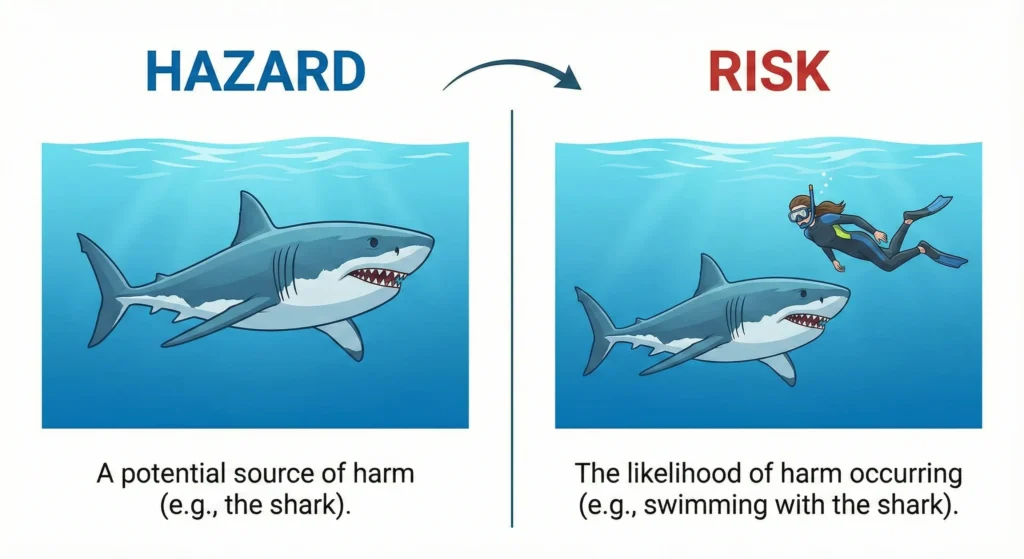
In everyday conversation, people use these words interchangeably. In safety, they are distinct. One is the source of danger; the other is the chance of harm.
The Risk Formula
We measure risk mathematically to decide which hazards need attention first.
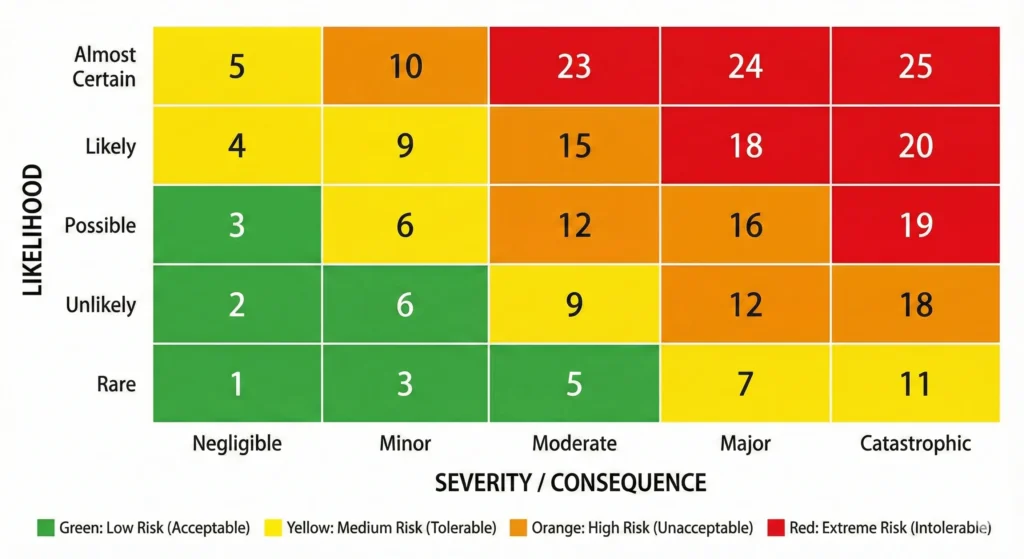
Likelihood (L)
How probable is the accident?
✖
Consequence (C)
How severe is the injury?
Can we reach Zero Risk?
It is crucial to understand that while hazards can sometimes be eliminated, risks can rarely be completely eliminated. There is no such thing as “Zero Risk.”
🛡️
Residual Risk
This is the risk that remains after we have implemented safety controls. Our goal is to lower the risk to a level that is acceptable (ALARP – As Low As Reasonably Practicable).
Lesson Summary
Risk Assessment is not just a good idea—it is a legal requirement.
✅ Hazard: The Shark in the water.
✅ Risk: Swimming with the Shark.