

Lesson 1: The Three Pillars of Safety (The Core “Why”)
Why Manage Safety?
It’s not just about checklists. It’s about the Moral, Legal, and Financial foundation of your business.
When people think of Health, Safety, and Environment (HSE), they often think of checklists, hard hats, and red tape. But safety isn’t just a box-ticking exercise. Before we learn how to be safe, we must understand why we do it.
1. Moral
The Heart.Protecting people because it’s the right thing to do.
2. Legal
The Backbone.Adhering to regulations to avoid prosecution.
3. Financial
The Wallet.Avoiding the massive costs associated with accidents.
1. The Moral Argument (The Right Thing to Do)
At its heart, safety is about people. Employers have a Duty of Care toward their employees, visitors, and contractors. This means taking reasonable steps to prevent harm.
The Global Reality
- The Human Cost: We aren’t just talking about numbers; we are talking about families.
- Staggering Statistics: Globally, 2.75 million people die from workplace injuries every year.
- Occupational Disease: Over 270 million people suffer from occupational diseases annually.
The Bottom Line: It is society’s expectation that no one should be killed or injured while trying to earn a living.
2. The Legal Argument (The Rules)
If the moral argument is the “heart” of safety, the legal argument is the “backbone.” Safety is not a choice; it is the law. Failure to comply leads to court cases, punitive damages, and enforcement actions.
3. The Financial Argument (The Costs)
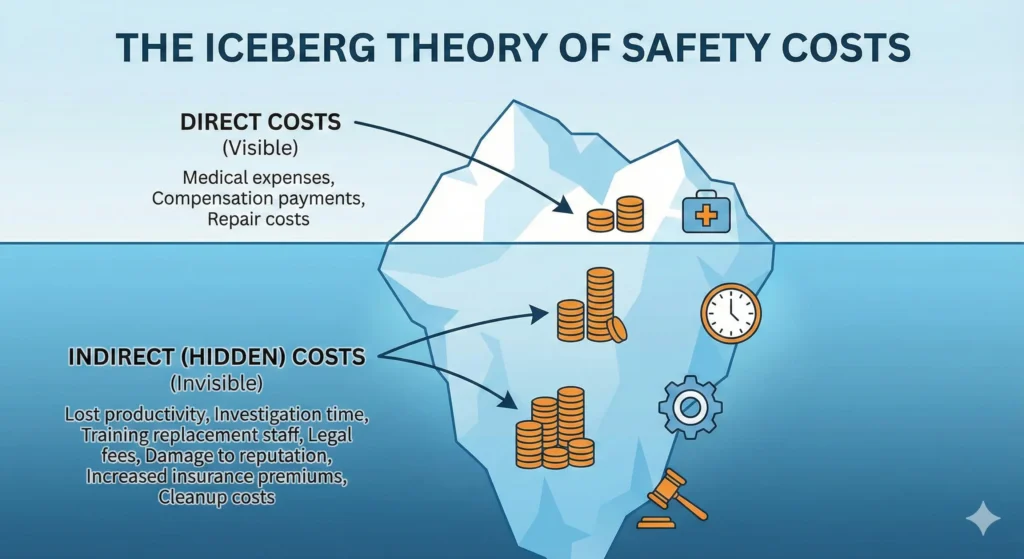
Many businesses wrongly assume that safety is expensive. The truth is that accidents are expensive. When an accident occurs, the costs are often described using the Iceberg Theory: what you see on the invoice is only a fraction of the total cost.
| Cost Type | Definition | Examples |
|---|---|---|
| Direct Costs | Costs that are billed and accounted for. | Medical treatment, sick pay, property repair. |
| Indirect Costs | Unbilled loss of resources (often 4x-10x higher). | Investigation time, reputation loss, poor morale. |
| Insured Costs | Costs covered by insurance policy. | Damage to plant/building, some medical costs. |
| Uninsured Costs | Costs insurance will NOT pay. | Fines, legal defense, lost raw materials, overtime. |
Lesson Summary
We manage safety for three simple reasons: